How to Write a WhatsApp Group Name, Description and Rules That Attract the Right Members
Updated 30 Oct 2026
Contents
- The group name: clear beats clever
- The group picture: simple and relevant
- The description: answer four questions
- Rules that people actually follow
- How to introduce rules without sounding strict
- Writing for directories and search
- Rules that fit different kinds of groups
- Writing for a multilingual audience
- Common mistakes
- Settings that support your rules
- A fill-in template
- Review your words every few months
- Your description is your group’s front door
When someone opens your group’s invite link, they see three things before deciding to join: a picture, a name and — if they look — a description. When they join, the description and rules shape how they behave for months. Yet most admins spend ten seconds on these and wonder later why their group attracts the wrong people or fills with spam. A few minutes of careful writing makes a lasting difference. This guide covers names, pictures, descriptions and rules, with examples you can adapt for almost any topic.
The group name: clear beats clever
A good name tells a stranger exactly what the group is, who it is for and, when relevant, where. Clever names and inside jokes work for friends; for groups that grow through links and directories, clarity wins.
A simple formula: Topic + Audience or Place + (optional) Type.
- “Freelance Web Designers – Pakistan”
- “Karachi Cricket Fans – Match Day Chat”
- “Class 9 Biology – Board Exam Help”
- “Lahore Home Bakers – Orders & Tips”
- “Daily Quran Reminders (Announcements)”
Avoid names that look like spam: all capital letters, many emojis, money promises (“EARN 5000 DAILY”), or brand names you do not own. They put serious people off, and directories — including ours — filter them out.
The group picture: simple and relevant
The picture appears as a small circle, so detail is lost. Use one clear object, logo or colour with strong contrast: a cricket ball, a book, a mosque silhouette, your shop’s logo. Avoid photos of people you do not have permission to use, and avoid images full of text, which are unreadable at that size and look like adverts.
The description: answer four questions
A strong description answers, in order:
- What is this group for? One sentence.
- Who should join? Beginners, professionals, a city, an age group.
- What happens here? Daily posts, weekly polls, job alerts, match discussions.
- What are the rules? Three to five short points.
Put the most important sentence first, because only the opening lines show in previews and in directory listings.
Example: a hobby group
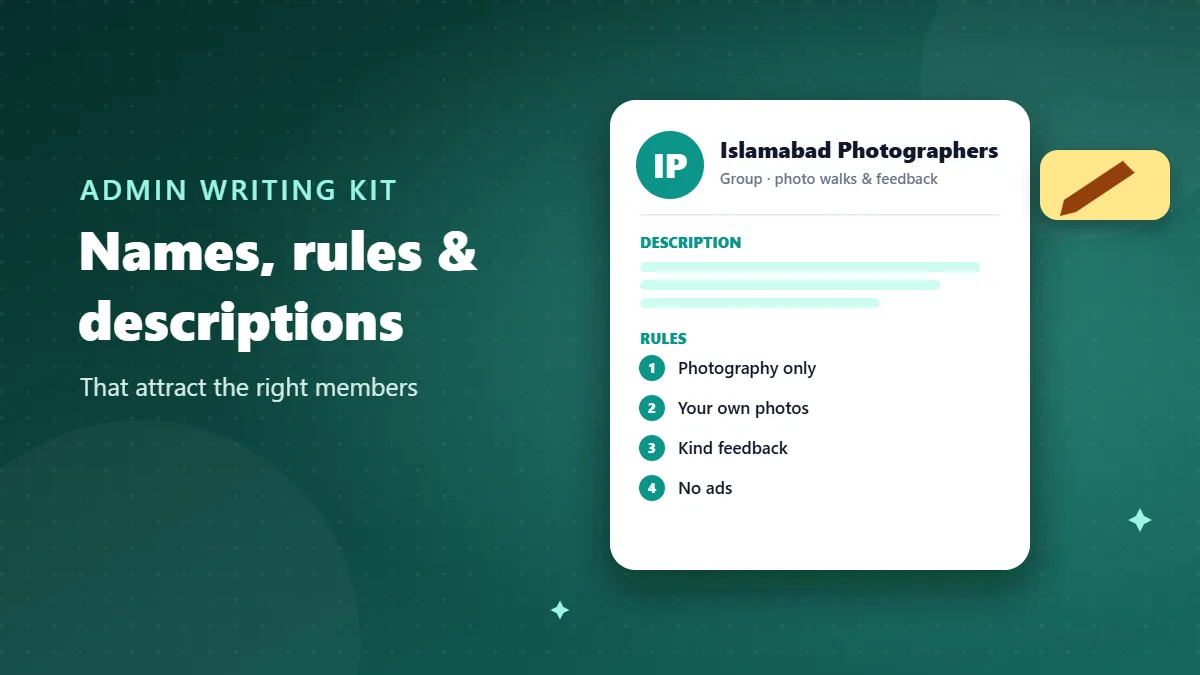
📸 A friendly group for beginner and intermediate photographers in Islamabad to share photos, get feedback and plan photo walks.
Every Sunday: photo challenge with a theme. Monthly: group photo walk (details posted here).
Rules: 1) Photography only. 2) Your own photos only. 3) Give kind, useful feedback. 4) No ads without admin approval. 5) Admins: Ali, Sara.
Example: a job group
Verified job openings in Lahore for accounting and finance roles. Admins post only jobs with a named company and an official way to apply.
Rules: 1) Members cannot post — send job tips to an admin. 2) No fees are ever charged for jobs shared here; report anyone who asks. 3) Never send your CV in the group.
Example: a shop group
New arrivals, restock alerts and member-only discounts from Ayesha’s Handmade Bags. Orders by private message only.
Rules: 1) Questions about products welcome. 2) Please don’t share prices outside the group. 3) Delivery updates are sent privately.
Rules that people actually follow
Rules work when they are short, specific and enforced. Compare:
| Vague rule | Specific rule |
|---|---|
| Be good | No insults, politics or religious debates |
| No spam | No forwards, links or ads without admin approval |
| Stay relevant | Cricket only — match talk, scores, club news |
| Respect privacy | No private messages to members without asking |
| Follow admins | Admins may remove anyone after one warning |
Five rules are usually enough. If you need more, it is often a sign the group’s purpose is too broad.
How to introduce rules without sounding strict
Tone matters. Rules framed as protection for members (“to keep this group useful for everyone…”) are accepted far better than commands. A friendly welcome message that links to the rules, posted every time new people join, sets expectations before anyone makes a mistake. When someone breaks a rule for the first time, a light, public reminder (“Hi Ahmed, please keep this group for jobs only — rule 1 🙂”) is usually all it takes.
Writing for directories and search
If you list your group in a directory, your name and description help people find it. Use the words people actually search for: “cricket”, “govt jobs”, “spoken English”, “Karachi”. Avoid stuffing keywords — one clear sentence with the right words is better than a list of tags. On our site, the description you write when submitting a group helps us create a better guide page for it, so a clear description directly improves how your group is presented.
Rules that fit different kinds of groups
Study and class groups
- Study content only — no memes or forwards.
- Ask questions with the chapter and page number.
- No sharing of leaked papers or paid material without permission.
- Quiet hours after 10 pm.
Buy and sell groups
- One post per item per day, with photos, price and location.
- Mark items as SOLD by editing or replying.
- Payments and negotiation by private message only.
- No fake payment screenshots — offenders removed and reported.
Family and friends groups
- Check before forwarding health or news messages.
- Big announcements here; daily chat in smaller groups.
- No politics if it causes arguments.
Religious and community groups
- Share a source for every verse, hadith or quote.
- No debates between sects or schools of thought.
- Event notices only from admins.
Using rules written for your type of group makes them feel natural rather than copied, and members are more likely to respect them.
Writing for a multilingual audience
Many groups include members who are more comfortable in different languages. If that is true for your group, write the description in the main language first, then add a short version of the rules in a second language below. Keep sentences simple and avoid slang that might be misunderstood. Rules that everyone can read are rules that everyone can follow — and they make it fair to enforce them.
Common mistakes
- Empty description. Members guess what is allowed, and guess differently.
- Rules hidden at the bottom of a long paragraph. Use numbered lines.
- Promises you cannot keep (“100% verified jobs”, “guaranteed results”). They damage trust when reality differs.
- Personal phone numbers of admins in the description, visible to anyone with the link. Members can already message admins from the participant list.
- Never updating. If the group changes — new admins, new weekly events — update the description and announce it.
Settings that support your rules
- Only admins can edit group info, so your name, picture and description stay as you wrote them.
- Approve new participants for public links, so you can turn away accounts that look like spam.
- Only admins can send messages for announcement groups, combined with a separate discussion group if needed.
- Pinned messages for the most important rule or the current weekly topic.
A fill-in template
[Emoji] [What the group is for] for [who] in [place, if relevant].
What happens here: [daily/weekly activity].
Rules: 1) [topic only] 2) No forwards or ads without approval 3) Be respectful 4) No private messages without permission 5) Admins: [names].
Review your words every few months
Groups change. The beginners you started with become experts, a weekly event moves to a different day, new admins join, and problems you never imagined appear. Every few months, read your name, description and rules as if you were a stranger seeing them for the first time. Do they still describe the group honestly? Is there a rule nobody needs any more, or a new problem that needs a rule? A short refresh — announced with a friendly message — keeps your group’s front door accurate and welcoming.
Your description is your group’s front door
Your name and description are the front door of your group. Make them clear enough that the right people walk in and the wrong ones walk past. Keep rules short, specific and visible, and enforce them kindly from day one. Do that, and you will spend far less time moderating — and far more time enjoying the community you built.
Frequently Asked Questions
How long can a WhatsApp group description be?
Descriptions can be fairly long, but only the first lines show in previews. Put the most important sentence first and keep rules short.
Should I use emojis in the group name?
One relevant emoji can help a name stand out, but too many make it look like spam and harder to search.
Do rules really change behaviour?
Yes, when they are short, specific and enforced consistently. Unenforced rules are ignored quickly.
Can I change the description after the group grows?
Yes. Update it whenever rules change, and post a short message so members know.