How to Use WhatsApp Study Groups for Exam Preparation (Without Wasting Time)
Updated 24 Oct 2026
Contents
- Why study groups work (when they work)
- Choosing the right study group
- Creating your own study group
- Study routines that work well on WhatsApp
- Sharing notes the right way
- Avoiding the classic distractions
- Be careful with “leaked papers” and paid notes
- Study group etiquette
- Exam week and results day
- For teachers and coaching institutes
- A simple four-week revision plan for a group
- Make your study group a tool, not a hangout
Most students are already in at least one class WhatsApp group. Some of these groups are gold: notes appear the night before a test, someone always knows the syllabus, and hard questions get answered in minutes. Others are a constant stream of memes, “did anyone do the homework?” and last-minute panic. The difference is not the students — it is how the group is set up and used. This guide explains how to choose, create and use study groups so they save you time instead of stealing it.
Why study groups work (when they work)
Learning with others helps in three ways. You get accountability: it is harder to skip revision when your group expects your summary tomorrow. You get explanation: explaining a topic to someone else is one of the most effective ways to remember it. And you get coverage: five people reading different chapters cover more ground than one person reading alone. A WhatsApp group makes all three possible every day, not only when you meet in person.
The risk is that the same app delivers family chats, games and endless videos. A study group only works if it protects focus instead of competing with it.
Choosing the right study group
- Same exam, same syllabus. A group for “all students” is too broad. Look for groups focused on your board, class, subject or entrance test.
- Active but not noisy. Look at the last few days of messages. Are people discussing questions and sharing resources, or mostly chatting?
- Clear admins and rules. Groups run by a teacher, a coaching institute or a responsible senior student usually stay on track.
- Size that fits the purpose. Large groups (hundreds of members) are fine for schedules and notes. For real discussion, a small group of classmates is better.
In our directory, study groups are listed under Education and Students. Use the descriptions to check the exam and level before joining.
Creating your own study group
- Pick four to fifteen people who are serious about the same exam. Quality matters more than numbers.
- Name it precisely, for example “Class 10 Physics – Board Exam Prep”.
- Write three rules in the description: study content only; no forwards or memes; questions must include the chapter or page number.
- Agree on a schedule — which chapters each week, and when the group will do a quiz.
- Use “Only admins can edit group info” so the name and rules stay in place.
Study routines that work well on WhatsApp
Daily question
One member posts one exam-style question each evening. Everyone attempts it before looking at others’ answers, then the poster shares the solution next morning. It takes ten minutes a day and keeps everyone revising.
Chapter summaries
Divide the syllabus. Each person writes a one-page summary of a chapter — key definitions, formulas, dates — and shares it as a clear photo or document. Over a few weeks the group builds a complete revision pack.
Polls as quick quizzes
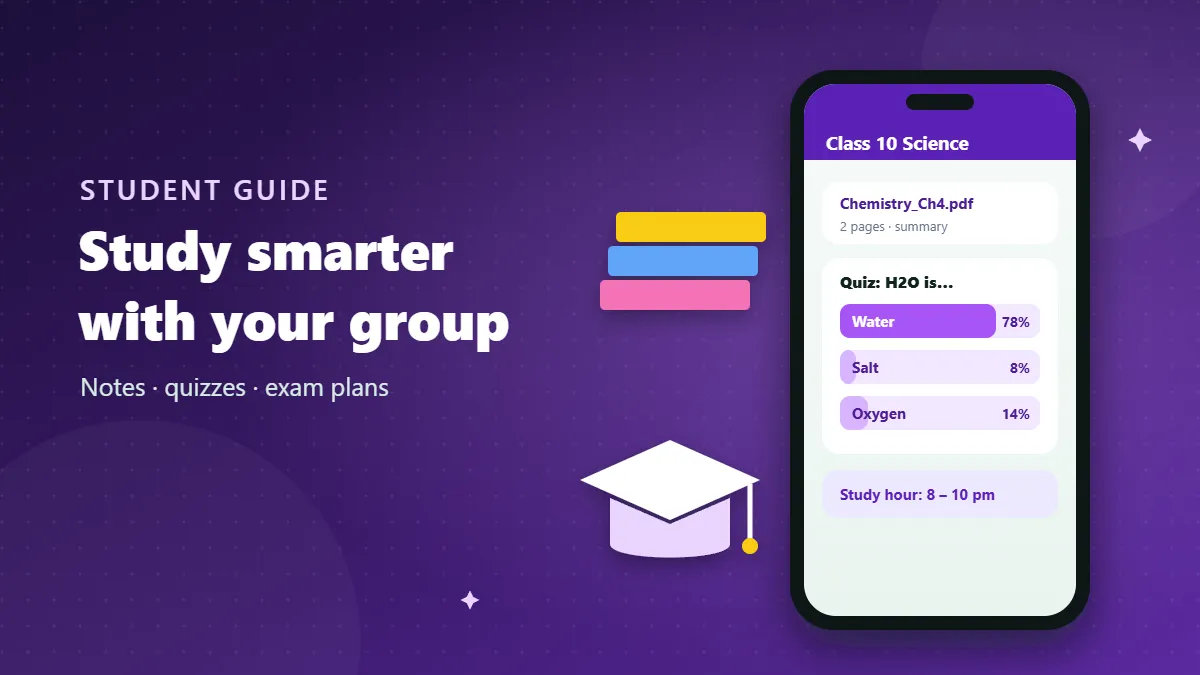
WhatsApp polls are perfect for multiple-choice practice. Post a question with four options; results show instantly which topics the group finds hard. Spend more time on those.
Voice explanations
Some concepts are easier to explain by voice. A two-minute voice note walking through a solution can help more than a long typed message — just keep it short and label it with the topic first.
Focused study hours
Agree on a daily slot, for example 8–10 pm, when everyone studies and only urgent study questions are posted. Some groups switch “Send messages” to admins only during this time, so the group goes quiet.
Sharing notes the right way
- Photos: take them in good light, flat, with the page fully in frame. Blurry notes waste everyone’s time.
- Documents: share PDFs instead of twenty separate photos. Free scanning apps can combine pages into one file.
- Names: rename files like “Chemistry_Ch4_Summary.pdf” so they can be found later with the search bar.
- Pin important files: admins can pin key messages — the syllabus, the date sheet, the formula list — at the top of the chat.
- Use starred messages: star anything you want to revise later, then open Starred messages before the exam.
Avoiding the classic distractions
- Mute the group and open it only during planned breaks. You do not need a buzz for every reply.
- Turn off media auto-download to avoid filling your phone with images you will never look at.
- Keep personal chats out. Create a separate friends group for fun; keep the study group clean.
- Use focus or do-not-disturb modes on your phone during deep study and allow only important contacts.
Be careful with “leaked papers” and paid notes
Every exam season, messages appear offering leaked papers, guaranteed questions or “confirmed” answers — usually for a fee. These are almost always scams or rumours, and spreading them can get students into serious trouble. Rely on official syllabi, past papers published by your board or university, and notes from teachers you trust. If someone in your group shares a “leak”, ask them to remove it and inform the admin.
Also be wary of groups that ask for money to unlock notes or “premium” material from unknown people. If a resource is valuable, it will be available from a reputable institute or publisher, with a receipt.
Study group etiquette
- Give before you take. If you only ask for notes and never share, people notice. Contribute summaries, answers or past papers.
- Ask complete questions. “Q7 page 112, Chemistry Ch 4 — why is the answer B and not C?” gets a useful reply; “anyone understand chapter 4?” does not.
- Credit sources. When sharing a teacher’s notes or a book’s explanation, say where it came from.
- Do not shame mistakes. A group where people are afraid to ask “basic” questions stops being useful to anyone who is struggling.
- Keep panic out. Messages like “I haven’t studied anything, we’re all going to fail” spread anxiety. Share a plan instead.
Exam week and results day
In the final days, change how the group works. Stop sharing new material — it only creates panic about topics you have not covered. Focus on quick revision: formula lists, key dates, short quizzes. Agree to go quiet the night before each paper so everyone sleeps. After each exam, avoid long post-mortems of every question; they cannot change the result and they drain energy for the next paper.
On results day, be careful with “result checking” links that ask for payment or personal details. Use only your board or university’s official website or SMS service. Celebrate successes, but remember that some members may be disappointed — a kind word in a private message means more than a public discussion of marks.
For teachers and coaching institutes
Teachers can get the benefits without the noise by using two spaces: an announcement-only group or a WhatsApp channel for homework, schedules and notes, and a smaller discussion group where students can ask questions during set hours. Clear office hours (“questions answered 5–7 pm”) protect your personal time, and pinned messages keep key information easy to find. Channels also protect students’ privacy, because followers cannot see each other’s numbers.
A simple four-week revision plan for a group
| Week | Group activity |
|---|---|
| 1 | Share the syllabus, divide chapters, each member writes summaries |
| 2 | Daily question plus poll quizzes on the summarised chapters |
| 3 | Timed past papers, then discuss the hardest questions together |
| 4 | Weak-topic review, formula and definition drills, rest before the exam |
After each week, take two minutes in the group to ask what worked and what did not, and adjust the plan. A plan the group shapes together is a plan the group actually follows.
Make your study group a tool, not a hangout
A study group is a tool, not a hangout. Keep it small, focused and organised, give it a routine, and mute it when you need to concentrate. Used this way, WhatsApp becomes one of the best study partners you have — available every evening, full of people working towards the same goal as you.
Frequently Asked Questions
How big should a study group be?
Between four and fifteen active members is ideal for discussion. Larger groups work better as announcement channels for notes and schedules.
Are leaked papers shared in groups real?
Almost never. They are a common scam or rumour. Rely on past papers and official syllabi from your board or university.
How do I stop a study group distracting me?
Mute it, check it only during planned study breaks, and keep one rule: study topics only.
Can teachers use WhatsApp groups?
Yes. Many teachers use announcement-only groups or channels for homework and schedules, with a separate small group for questions.