How to Find Genuine Job Groups on WhatsApp (and Avoid Job Scams)
Updated 22 Oct 2026
Contents
- What makes a job group genuine?
- Where to find good job groups
- How to check a job post in five minutes
- The most common job scams on WhatsApp
- Applying safely
- How to reply to a genuine job post
- If you have already been scammed
- Getting the most from a good job group
- Red flags at a glance
- Use job groups as leads, then verify
For many job seekers, WhatsApp groups have become a daily habit. A good group can bring you openings before they appear on job boards, connect you with recruiters, and help you learn which companies are hiring in your city. A bad one can cost you money, your personal documents, or months of chasing jobs that never existed. The difference is not always obvious from the group name. This guide shows how to find job groups worth joining, how to check each job post, and how to apply without putting yourself at risk.
What makes a job group genuine?
Genuine job groups share a few traits. They have a clear focus — a city, an industry or a type of job — rather than promising “jobs for everyone”. Their admins are identifiable: a recruitment agency, a training institute, an alumni association, or an experienced professional who shares openings from known companies. Posts include the company name, the location, the role, and an official way to apply. And crucially, nobody asks you for money.
Groups that look professional but never name a company, always ask you to “DM admin for details”, or mix jobs with investment offers are not job groups — they are funnels.
Where to find good job groups
- Your institute or university. Alumni and placement-office groups are among the most reliable, because the admins are accountable to the institution.
- Professional associations. Engineers, nurses, accountants, teachers and IT professionals often have city-level groups run by members who know the industry.
- Recruitment agencies with a real presence. Agencies that also have a website, office address and registration number are far safer than anonymous “HR teams”.
- Official government job channels. For public-sector jobs, follow only the channels linked from official department websites; announcements there point back to official application portals.
- Curated directories. On our site, job groups and channels are listed under the Jobs and Govt Jobs categories, checked for active links and screened for scam wording. Always apply the checks below anyway.
How to check a job post in five minutes
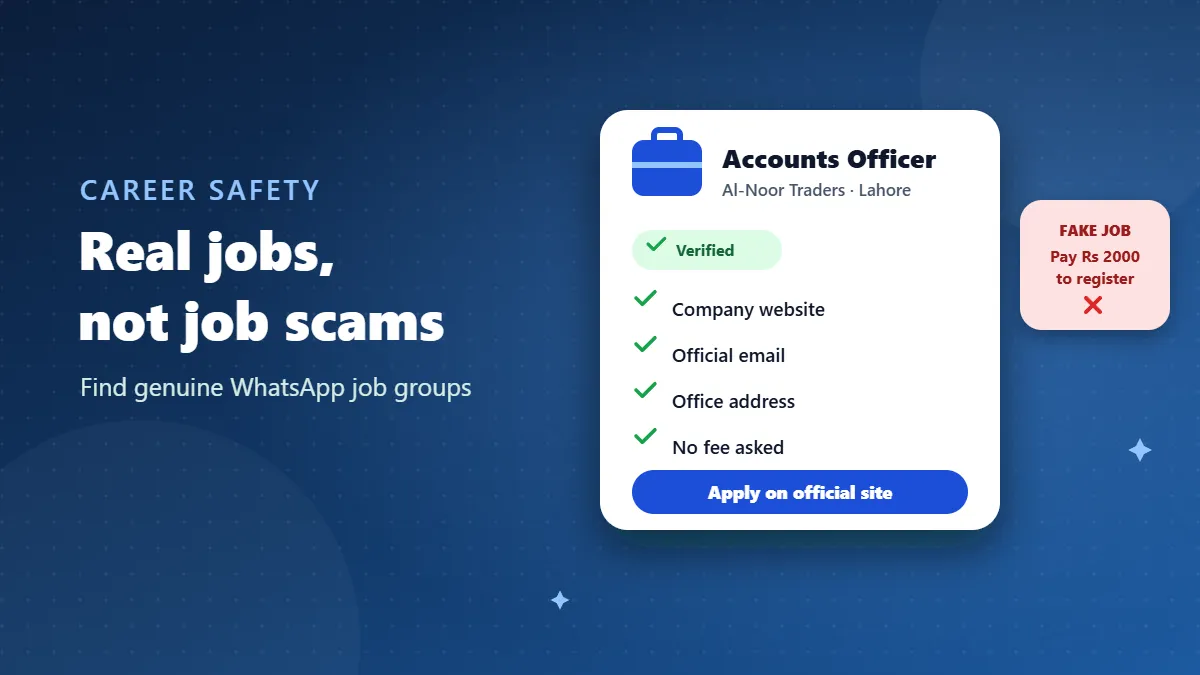
- Find the company. Search the company name. Does it have a website, an office address and an online footprint older than a few weeks?
- Find the job on an official page. Real openings usually appear on the company’s careers page, its official social media, or a well-known job portal. If the job exists only in WhatsApp forwards, be cautious.
- Check the contact details. Official recruiters use company email addresses, not free webmail accounts with random numbers. A single mobile number with no company name is a weak signal.
- Compare the salary. A data-entry job paying three times the normal rate, or an overseas job with a free visa and huge salary for no experience, is almost always bait.
- Look for a fee. If, at any point, you are asked to pay for registration, training, uniforms, medical tests, visa processing or “security”, stop.
The most common job scams on WhatsApp
Task-based “jobs”
You are offered money for liking videos, writing reviews or rating hotels. The first few tasks pay small amounts to win your trust. Then you are told to “upgrade” or “recharge” to unlock better-paying tasks — and the money disappears. Real companies do not pay people to fake reviews, and they never ask workers to deposit money.
Overseas jobs with fees
Ads promise jobs abroad with accommodation and visas included. After an “interview” over WhatsApp, you are asked to pay for visa processing, medical tests or air tickets. Licensed overseas employment promoters operate from registered offices and follow government rules; check their licence with the relevant authority in your country before paying anything.
Work-from-home data entry
You are sent a “registration form” and asked to pay a small fee for the software or a training kit. Sometimes you receive work, but payment is always delayed until you pay a “penalty” for mistakes. Legitimate remote work never begins with a charge.
Fake government recruitment
Messages announce urgent vacancies in a government department with a link to a look-alike website that charges an application fee or collects your ID details. Always apply through the department’s official portal, typed directly into your browser.
Identity harvesting
Some “jobs” are only a way to collect copies of ID cards, passports and bank details, which are later used for fraud. Be careful with documents, especially before any official offer.
Applying safely
- Never post your CV in a group. It contains your phone, email and address. Send it only to verified company addresses or forms.
- Create a separate email for job hunting so your main inbox is not flooded with spam if your CV is passed around.
- Watermark sensitive documents. If you must share an ID copy after an offer, add a line such as “For [Company] job application only – [date]” across it.
- Meet in public, official places. Real interviews happen at offices, known venues, or on video calls with company accounts — not in private homes or random cafés with “agents”.
- Keep records. Save job posts, chats and email addresses. If something goes wrong, you will need them.
How to reply to a genuine job post
When a post checks out, your first message matters. Recruiters receive dozens of “interested” or “send details” replies; most are ignored. A short, complete message stands out:
Hello, I am applying for the [job title] position at [company] posted in [group name]. I have [X years] of experience in [skill] and live in [area]. I have emailed my CV to [official email]. I am available for an interview from [date]. Thank you.
This shows you read the post, gives the recruiter everything needed to shortlist you, and keeps your CV off the chat. Write in full sentences and avoid voice notes for a first contact; a clear text message is easier to forward to the hiring manager.
If you have already been scammed
- Stop all payments and communication immediately, even if they promise a refund after “one last fee”.
- Contact your bank or mobile wallet provider to try to stop or trace the transfer.
- Save every chat, number, receipt and screenshot.
- Report the number and the group inside WhatsApp, and inform the group admin if the admin is not involved.
- File a complaint with your country’s cybercrime or consumer protection authority.
- If you shared ID documents, watch for misuse: unknown SIM cards, loans or accounts in your name.
Being scammed is not a sign of foolishness — these schemes are designed by professionals to exploit people under pressure. Reporting helps stop the next victim.
Getting the most from a good job group
Once you find a genuine group, it can be a powerful tool. Mute it so it does not overwhelm you, but check it at a fixed time each day. Use the search inside the chat to filter by keywords like your city or skill. When you get a job through a group, share the experience — honest feedback helps others trust real recruiters and avoid fake ones. And if you see a scam post, report it to the admins privately so they can remove it before others fall for it.
Red flags at a glance
| Red flag | Why it matters |
|---|---|
| Any fee before joining | Real employers pay you; they do not charge you |
| Salary far above normal | Used to override your caution |
| No company name or address | Nothing to verify, nobody accountable |
| Interview only by chat | Real hiring includes a call or meeting with the company |
| Urgency: “join today or lose seat” | Pressure stops you checking |
| Request for OTP or bank login | Always a scam, no exceptions |
Use job groups as leads, then verify
Treat WhatsApp job groups as a lead source, not as the final step. Use them to discover openings, then confirm every job through official channels before you share documents or apply. Patience feels slow when you need work urgently, but the five minutes you spend checking a post can save you weeks of trouble and money you cannot afford to lose.
Frequently Asked Questions
Do real employers post jobs in WhatsApp groups?
Some do, especially small businesses and recruiters. But you should always confirm the job through an official website, email address or office.
Is it normal to pay a fee for a job interview?
No. Genuine employers do not charge interview, registration or training fees. A fee request is the strongest sign of a scam.
Should I send my CV in the group?
No. Never post your CV publicly. Send it only to a verified company email or an official application form.
What are safe documents to share?
Share your CV with verified employers. Share ID copies only after an official offer, and watermark them with the company name and date.